Envelope budgeting sounds almost too simple to work; yet millions of people swear by it as the system that finally made their finances click.
The idea is simple: divide income into labeled envelopes for each expense and spend only what’s in each.
No overdrafts, no surprises, no “where did it all go?” moments. Simple on the surface, but surprisingly powerful underneath.
What Is Envelope Budgeting?
Envelope budgeting is a cash-based system where you divide your monthly income into labeled envelopes, each representing a specific spending category; once an envelope is empty, spending in that category stops.
Also called the “envelope system,” “cash stuffing,” or “bucket budget,” this method started as a pre-digital tool for households to physically track and manage spending before banking apps.
Each envelope serves as a strict spending limit, preventing unnoticed overspending. Now, this concept is used in digital apps and virtual “buckets,” accessible even to those who seldom use cash.
How Does the Envelope Budgeting System Work?
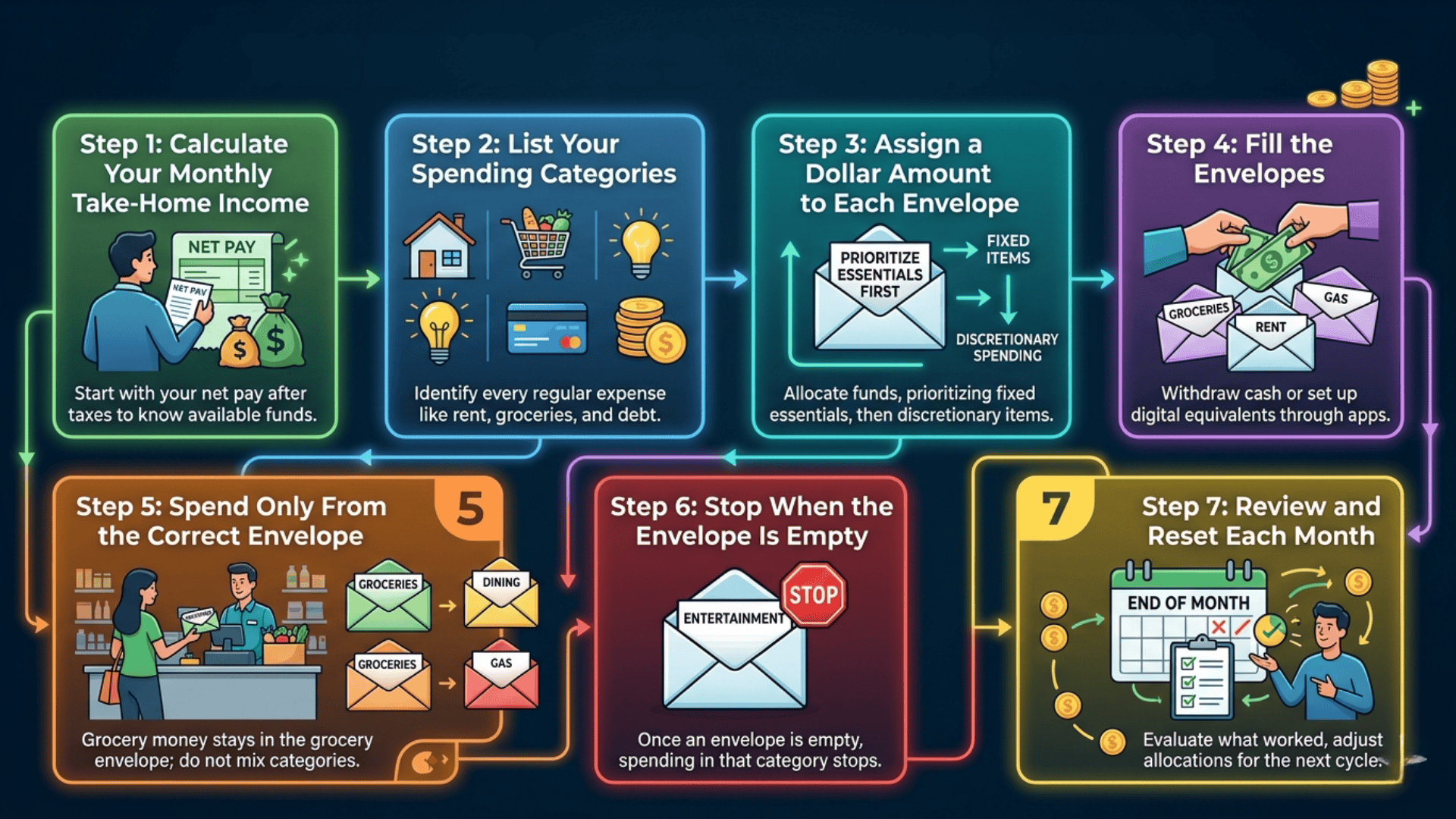
The envelope budgeting system works by giving every dollar a designated purpose before the month begins, eliminating guesswork and keeping your spending firmly within set boundaries.
- Step 1: Calculate Your Monthly Take-Home Income: Start with your net pay after taxes, as this is the actual amount available to allocate across your envelopes.
- Step 2: List Your Spending Categories: Identify every area you regularly spend on: groceries, rent, utilities, gas, dining, entertainment, savings, and debt repayment.
- Step 3: Assign a Dollar Amount to Each Envelope: Prioritize fixed essentials like rent and utilities first, then allocate the remaining funds to discretionary categories.
- Step 4: Fill the Envelopes: Withdraw cash and physically stuff each labeled envelope, or set up digital equivalents through a budgeting app or virtual accounts.
- Step 5: Spend Only From the Correct Envelope: Grocery money stays strictly in the grocery envelope; mixing categories defeats the entire purpose of the system
- Step 6: Stop When the Envelope Is Empty: Once an envelope runs out, spending in that category stops completely until the next monthly reset.
- Step 7: Review and Reset Each Month: At month’s end, evaluate what worked, what fell short, and adjust your allocations accordingly for the next cycle.
The Core Principles Behind Envelope Budgeting
Envelope budgeting isn’t just about sorting cash into labeled sleeves; it’s built on three foundational principles that together create a system of complete financial control and awareness.
- Intentional Spending: Every dollar is assigned a specific job before it’s ever spent, ensuring each purchase is planned rather than impulsive.
- Accountability: Physical cash or virtual limits act as a hard stop, making it structurally impossible to overspend without a deliberate, conscious decision.
- Visibility: At any moment, you can see exactly how much remains in each category, giving you a crystal-clear picture of your finances.
Note: Under the Zero-Based Budgeting Connection, savings and investments count as categories too, so every dollar has a deliberate purpose rather than disappearing unnoticed.
Envelope Budgeting Categories: What Should You Include
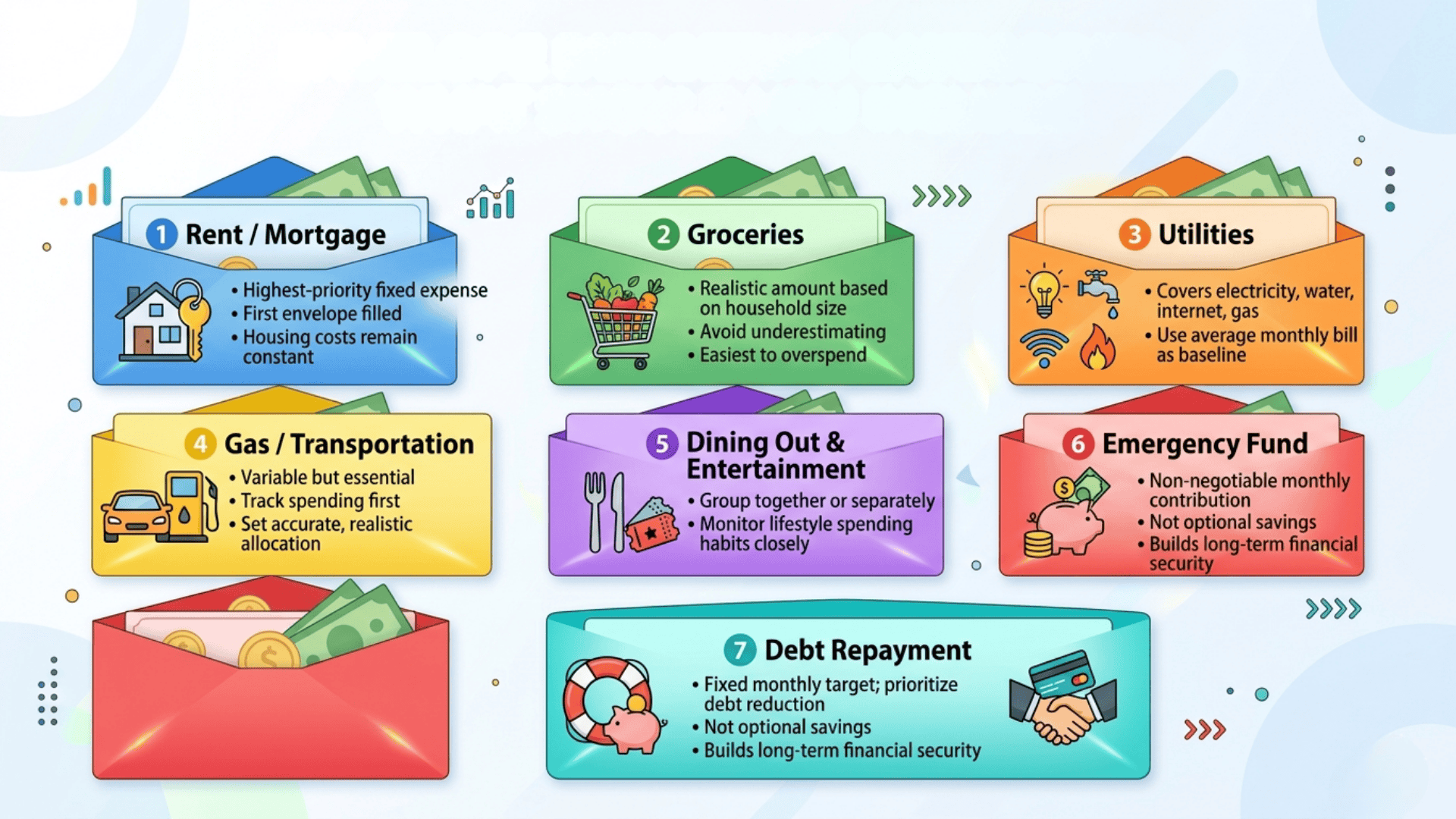
Choosing the right categories is the backbone of a successful envelope budget; the goal is to cover every predictable expense, so no spending catches you off guard at month’s end.
- Rent / Mortgage: This is your highest-priority fixed expense and should be the first envelope filled, as housing costs remain constant every month.
- Groceries: Allocate a realistic amount based on your household size, and avoid underestimating, as this is one of the easiest categories to overspend in.
- Utilities: Cover electricity, water, internet, and gas bills here; use your average monthly bill as a baseline estimate for each cycle.
- Gas / Transportation: A variable but essential category; track spending for a few months first to set an accurate, realistic allocation for this envelope.
- Dining Out & Entertainment: Group these discretionary categories together or separately, depending on how closely you need to monitor your lifestyle spending habits.
- Emergency Fund: Treat this as a non-negotiable monthly contribution, not optional savings; consistency here is what builds long-term financial security.
- Debt Repayment: Assign a fixed monthly target toward loans or credit cards, ensuring debt reduction stays a priority rather than an afterthought each month.
Cash vs. Digital Envelope Budgeting : Which Is Right for You
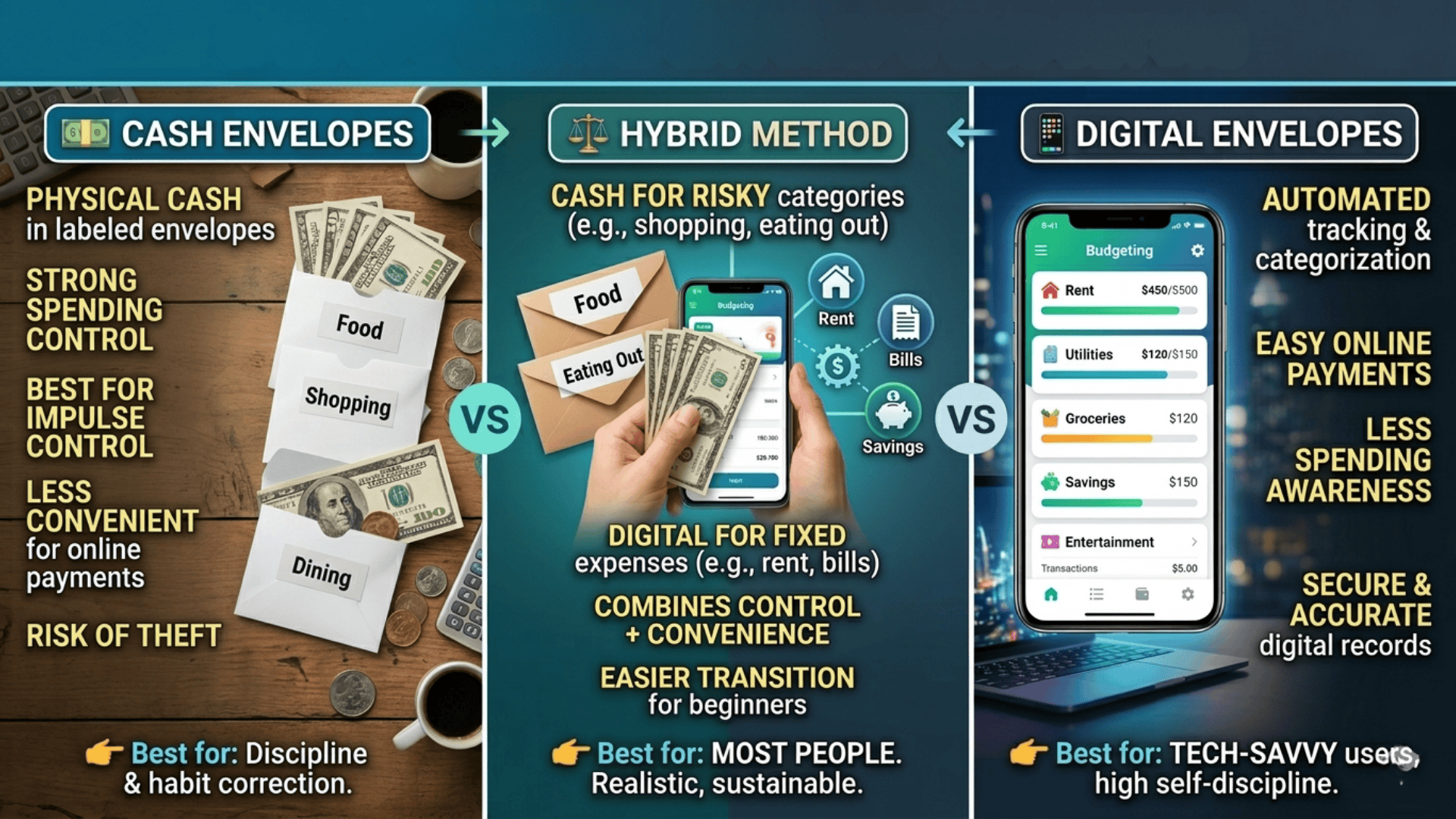
Envelope budgeting helps assign every rupee a job, but the format you choose affects how well you stick to it. Your lifestyle and spending habits should guide the decision.
| CRITERIA | TRADITIONAL CASH ENVELOPE BUDGETING | DIGITAL ENVELOPE BUDGETING |
|---|---|---|
| How It Works | Physical cash divided into labeled envelopes | Apps, spreadsheets, or bank sub-accounts track categories |
| Best For | Visual learners, impulse spenders, cash-only discipline | Card users who prefer digital tracking |
| Spending Control | Strong, tangible limit once cash runs out | Requires self-control without physical limits |
| Convenience | Less convenient in a cashless economy | Highly convenient for online and card payments |
| Security | Risk of carrying or losing cash | More secure with bank/app protections |
| Flexibility | Harder to adjust mid-month | Easy to reallocate funds instantly |
| Ideal Use Case | Strict budgeting for problem categories | Overall financial planning and tracking |
Note: A hybrid approach often works best. Use cash for high-risk spending areas and digital tools for everything else.
Pros and Cons of the Envelope Budgeting System
The envelope system is simple but powerful. Still, it is not perfect in every way, and understanding both sides helps you decide whether it fits your lifestyle.
| PROS | CONS |
|---|---|
| Creates clear spending limits and hard stops | Carrying cash is inconvenient and can be unsafe |
| Reduces impulse spending by adding friction | Time-intensive to set up and maintain |
| Makes spending visible and tangible | Not ideal for online or digital purchases |
| Beginner-friendly and easy to follow | Managing irregular expenses can be tricky |
| Works with or without technology | Requires consistent discipline to sustain |
| Helps reduce or eliminate credit card debt | No rewards or cashback benefits |
| Cash feels more “real,” improving control | Less flexibility compared to digital systems |
Who Should Use the Envelope Budgeting System?
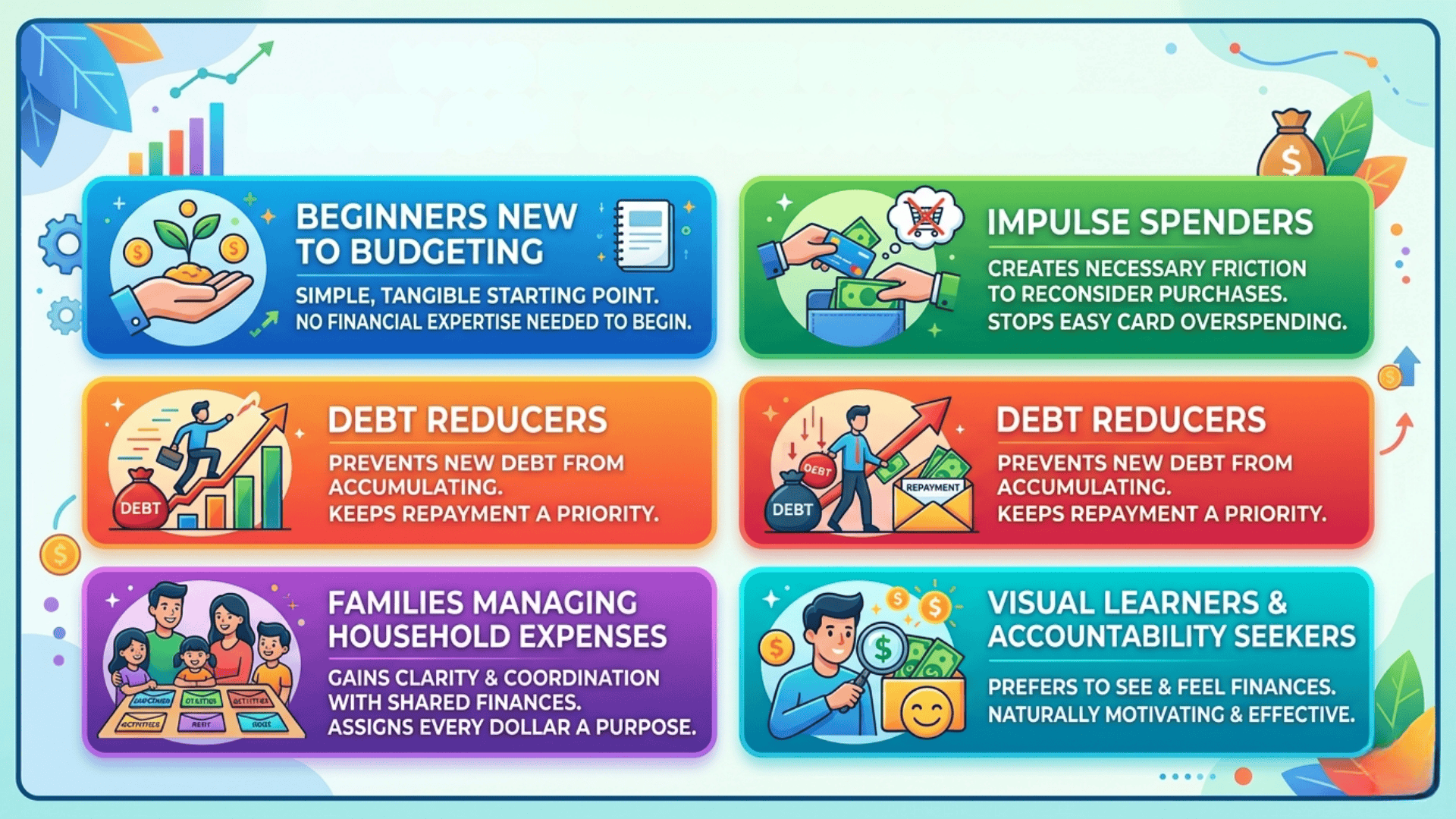
The envelope system isn’t a one-size-fits-all solution, but it’s particularly powerful for certain types of spenders who need structure, visibility, and firm financial boundaries in their daily lives.
- Beginners New to Budgeting: If you’ve never followed a budget before, the envelope system offers a simple, tangible starting point that requires no financial expertise whatsoever.
- Impulse Spenders: If debit and credit cards make it too easy to overspend, physical cash creates the friction needed to pause and reconsider unnecessary purchases.
- Debt Reducers: Those actively working to eliminate credit card debt benefit greatly from a system that prevents new debt from accumulating while keeping repayment a priority.
- Families Managing Household Expenses: With multiple spending categories and shared finances, families gain clarity and coordination by assigning every dollar a clear, agreed-upon purpose.
- Visual Learners and Accountability Seekers: Anyone who needs to see and feel their finances rather than just track numbers on a screen will find this system naturally motivating and effective.
Envelope Budgeting vs. Other Budgeting Methods
Different budgeting methods serve different financial styles. Comparing them helps you choose one that aligns with how you naturally manage money.
| METHOD | BEST FOR |
|---|---|
| Envelope Budgeting | Tactile control of variable spending |
| 50/30/20 Rule | Simple, percentage-based money allocation |
| Zero-Based Budgeting | Full control over every rupee of income |
| Pay-Yourself-First | Prioritizing savings before spending |
Tip: You can combine methods for better results. For example, apply the 50/30/20 rule by grouping envelopes into needs (50%), wants (30%), and savings or debt (20%) to maintain structure with flexibility.
Common Envelope Budgeting Mistakes to Avoid
Even the most well-intentioned budgeters can fall into predictable traps that quietly undermine the entire envelope system before it has a chance to work.
- Borrowing From Other Envelopes Regularly: Occasionally shifting funds is acceptable, but making it a habit completely defeats the purpose and discipline on which the system is built.
- Ignoring Irregular and Annual Expenses: Forgetting to account for car insurance, holiday gifts, or annual subscriptions will throw your entire budget off when those bills unexpectedly arrive.
- Making Categories Too Broad or Vague: An envelope labeled “miscellaneous” or “stuff” gives you no real spending clarity, undermining the visibility that makes this system effective.
- Forgetting to Track Digital Purchases: If you’re running a hybrid system, untracked online transactions can silently drain your budget without ever touching a physical envelope.
- Giving Up After One Imperfect Month: No budget is perfect in the first month. The system rewards consistency and gradual adjustment, not flawless execution from day one.
How to Handle Irregular and Annual Expenses
Irregular expenses are one of the biggest budget-busters, but with a simple monthly set-aside strategy, they become predictable, manageable costs that never catch you off guard.
- Divide Annual Costs Into Monthly Contributions: Take any large annual expense, such as car insurance or home repairs, and divide the total by 12. Set that amount aside in a dedicated envelope each month.
- Label Specific Envelopes for Each Irregular Expense: Create clearly named envelopes such as “Car Insurance,” “Holiday Gifts,” and “Home Repairs” so funds are always earmarked and never accidentally spent elsewhere.
- Treat These Allocations as Non-Negotiable Fixed Expenses: Just like rent or utilities, irregular expense envelopes should be filled first every month, removing any temptation to skip contributions when money feels tight.
Wrapping It Up
Envelope budgeting isn’t a trend; it’s a time-tested system that puts you back in control of your money, one category at a time.
Whether you use physical cash or a digital app, the core principle remains unchanged: every dollar has a purpose, and nothing gets spent without intention.
If you’ve been searching for a simpler, more honest relationship with your finances, what is envelope budgeting may just be the answer you didn’t know you needed.
The post What Is Envelope Budgeting and How It Works appeared first on Mothers Always Right.