Thousands of Publicly Exposed MLflow Instances — A Hidden Risk in MLOps Infrastructure

Summary
MLflow is widely used by machine learning and data science teams to track experiments, store artifacts, manage model versions, and organize the machine learning lifecycle.
During internet-wide reconnaissance, I observed 25,000+ publicly accessible MLflow instances using FOFA, Shodan and other asset query tools.
Many of these instances appeared to be exposed without authentication, which means anyone on the internet may be able to access MLflow dashboards and APIs.
This can lead to exposure of machine learning experiments, model artifacts, datasets, internal project names, and model registry information.
This issue is not best described as a traditional MLflow software vulnerability. Instead, it is a deployment security and secure-by-default posture issue.
What is MLflow?
MLflow is an open-source platform used for managing the machine learning lifecycle.
It is commonly used for:
- Tracking ML experiments
- Storing metrics and parameters
- Managing model artifacts
- Registering models
- Comparing training runs
- Managing model versions
- Supporting MLOps workflows
MLflow is used by data scientists, ML engineers, AI teams, research teams, and enterprise organizations to manage machine learning projects.
A typical MLflow setup contains:
- MLflow Tracking Server
- MLflow Web UI
- Backend Store
- Artifact Store
- Model Registry
Because of this, MLflow often contains sensitive information such as models, datasets, experiment results, and internal ML workflows.
Description
During the research, many MLflow services were found to be publicly exposed on the internet without authentication.
MLflow provides authentication and security controls, but these protections need to be configured correctly by the operator.
By default, MLflow binds to 127.0.0.1, which means it is local-only. However, if someone starts the server with:
mlflow server --host 0.0.0.0
or exposes it through a public reverse proxy, cloud load balancer, Kubernetes ingress, or open firewall rule, the MLflow service may become accessible from the internet.
If authentication is not enabled, anyone can potentially access the MLflow UI and API endpoints.
Reconnaissance
The exposed MLflow instances were identified using public search engines.
FOFA Query
title="MLflow"
FOFA Link:
https://en.fofa.info/result?qbase64=dGl0bGU9Ik1MZmxvdyIg
Shodan Query
http.title:"MLflow"
Shodan Link:
https://www.shodan.io/search?query=http.title%3A%22MLflow%22
Total observed instances:
25000+
Note: This count should be treated as a point-in-time estimate based on public search results.
Proof of Concept
FOFA Result
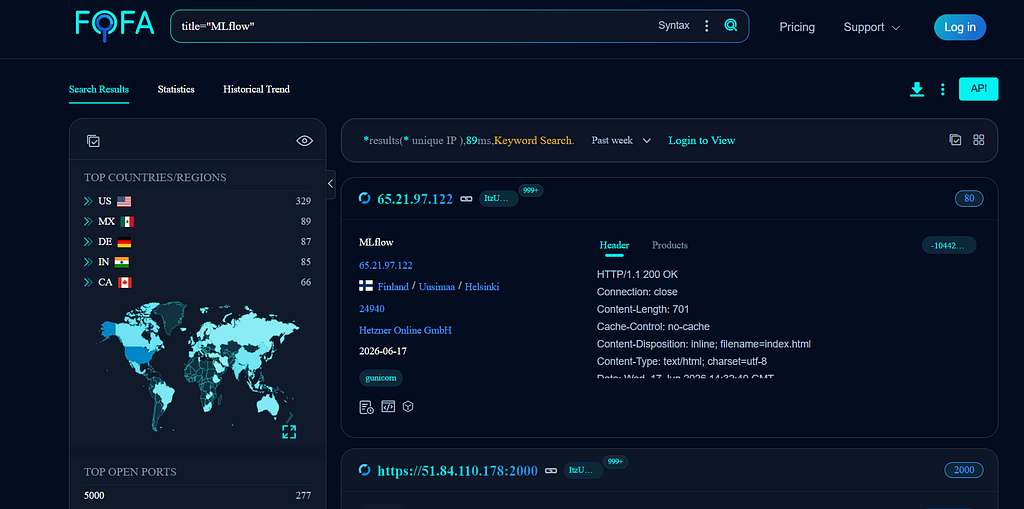
FOFA results showing publicly accessible MLflow instances.
Shodan Result
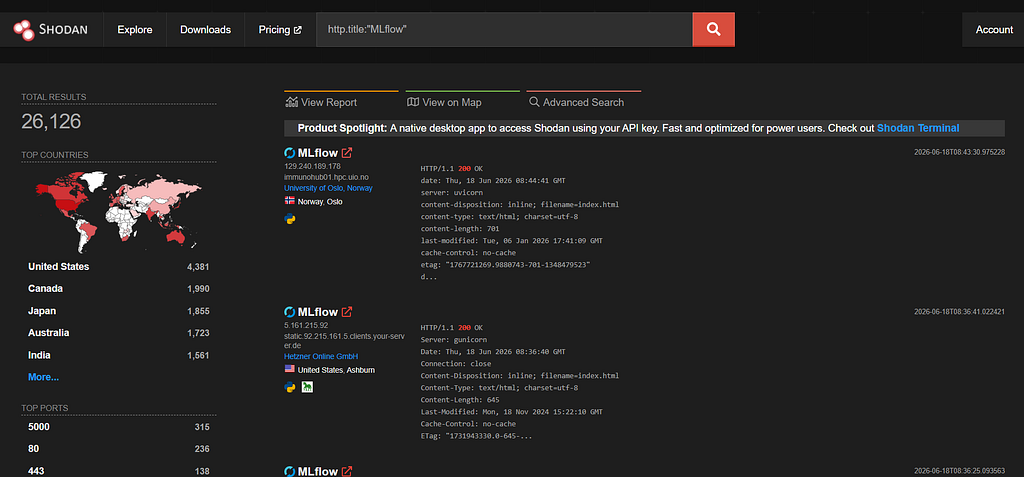
Shodan results showing MLflow instances exposed on the internet.
MLflow Instance Example
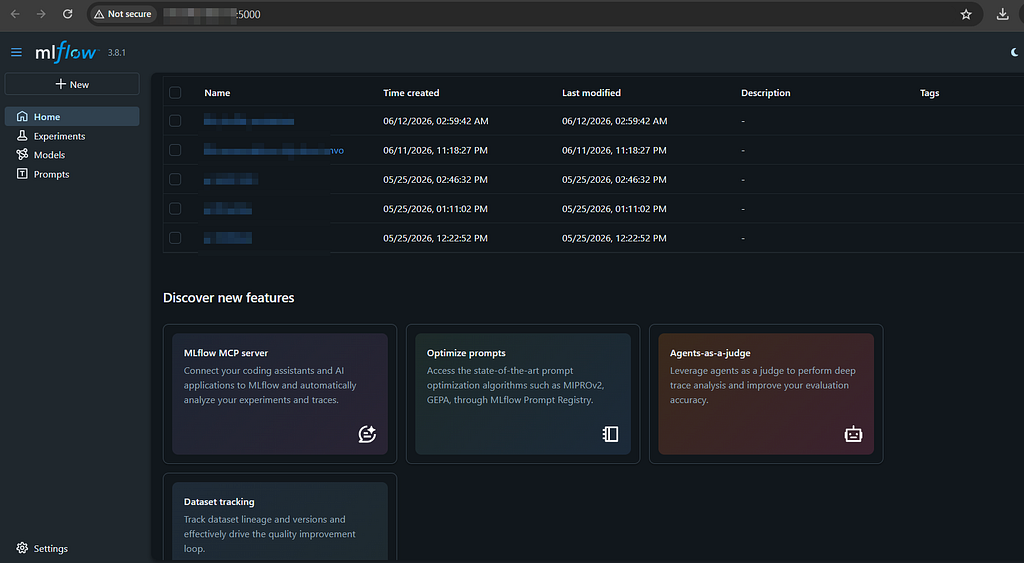
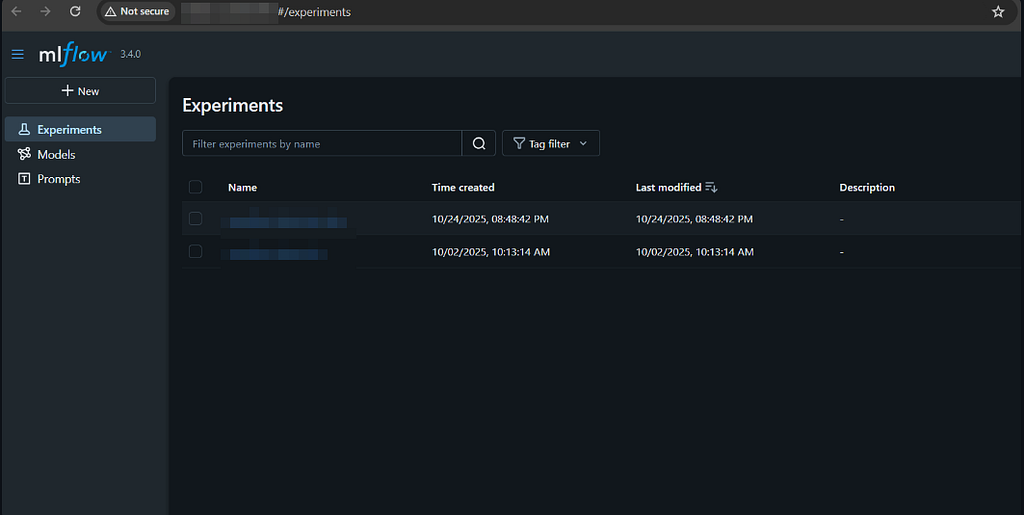
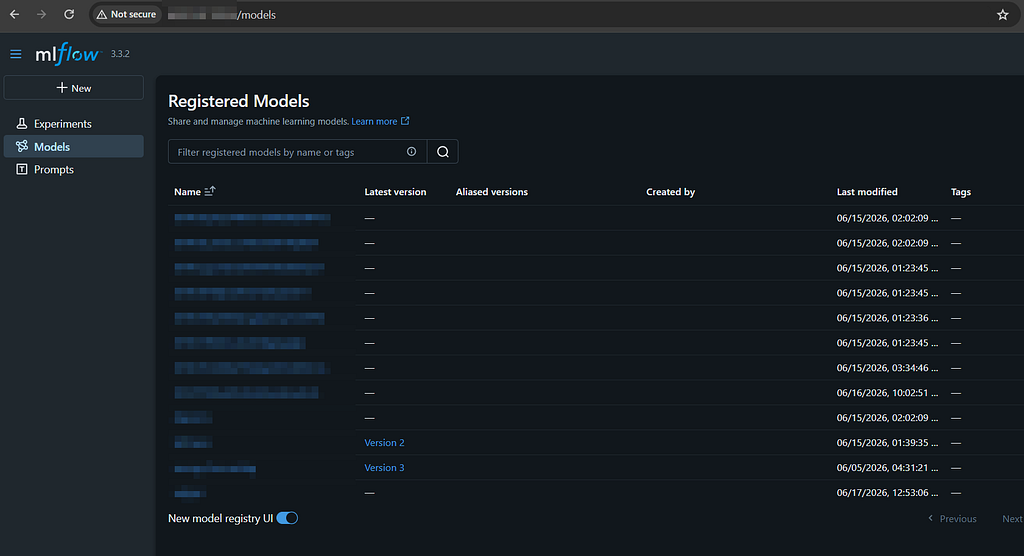
Example of an exposed MLflow dashboard. Sensitive details should be redacted.
What Can an Attacker Do?
If an MLflow instance is exposed without authentication, an attacker may be able to:
- View experiments
- View run metadata
- Access parameters and metrics
- Identify internal project names
- List artifacts
- Access model files
- View registered models
- Create or delete runs
- Modify experiment data
- Register or overwrite models
- Abuse artifact storage
- Disrupt ML workflows
The exact impact depends on the MLflow configuration and backend storage permissions.
Example Read-Only Validation
A read-only request can be used to check whether the service is MLflow:
curl -i https://mlflow.example.com/version
Experiment search example:
curl -sS https://mlflow.example.com/api/2.0/mlflow/experiments/search \
  -H 'Content-Type: application/json' \
  -d '{"max_results":5}'
Run search example:
curl -sS https://mlflow.example.com/api/2.0/mlflow/runs/search \
  -H 'Content-Type: application/json' \
  -d '{"experiment_ids":["1"],"max_results":5}'
These examples should only be used on systems you own or are authorized to test.
Impact
The impact of exposed MLflow services can be serious.
Confidentiality Impact
An attacker may access:
- ML experiments
- Model artifacts
- Training metadata
- Dataset references
- Internal project names
- Model registry information
- Cloud storage paths
This can lead to leakage of proprietary machine learning research and intellectual property.
Integrity Impact
An attacker may be able to:
- Modify experiments
- Create fake runs
- Delete runs
- Register unauthorized models
- Tamper with model registry data
This can impact trust in ML workflows and model governance.
Availability Impact
An attacker may disrupt ML operations by:
- Deleting runs
- Removing artifacts
- Breaking registry state
- Polluting experiment history
- Affecting downstream deployment workflows
CVSS Calculation
For a fully exposed MLflow instance with no authentication and accessible APIs, the severity can be considered Critical.
CVSS:3.1/AV:N/AC:L/PR:N/UI:N/S:U/C:H/I:H/A:H
Score:
9.8 Critical
This may vary depending on the environment, artifact permissions, and whether additional access controls are present.
Important Clarification
This is not a single version-specific vulnerability.
MLflow already provides security features such as:
- Localhost binding by default
- Built-in authentication
- Security middleware
- Host validation controls
- Reverse proxy deployment support
The real issue is that many deployments are exposed publicly without these protections enabled.
A better way to describe the issue is:
Publicly exposed unauthenticated MLflow deployments
rather than:
MLflow authentication bypass
Secure-by-Default Concern
Although MLflow provides authentication and security features, many users may still accidentally expose MLflow while testing or deploying quickly.
Some improvements that could reduce accidental exposure include:
- Strong warning when using --host 0.0.0.0 without authentication
- Security warning in startup logs
- Explicit confirmation before public unauthenticated binding
- More visible security guidance in quickstart documentation
- Authentication enabled by default for non-local deployments
- Explicit opt-out for unauthenticated public access
These changes could help new users avoid accidentally exposing sensitive ML infrastructure.
Mitigation
Organizations running MLflow should take the following actions.
1. Do Not Expose MLflow Directly to the Internet
Use:
- VPN
- Private network
- Internal load balancer
- IP allowlist
- Zero Trust access
- Private Kubernetes ingress
2. Enable Authentication
Use MLflow built-in authentication:
pip install 'mlflow[auth]'
export MLFLOW_FLASK_SERVER_SECRET_KEY='replace-with-strong-secret'
mlflow server \
  --host 127.0.0.1 \
  --port 5000 \
  --app-name basic-auth
3. Use Reverse Proxy Authentication
Place MLflow behind NGINX, OAuth2 Proxy, SSO, or an identity-aware gateway.
Example:
server {
    listen 443 ssl;
    server_name mlflow.example.com;
auth_basic "Restricted MLflow";
auth_basic_user_file /etc/nginx/htpasswd;
location / {
        proxy_pass http://127.0.0.1:5000;
        proxy_set_header Host $host;
        proxy_set_header X-Forwarded-Proto $scheme;
    }
}
4. Restrict Artifact Storage
Ensure artifact stores such as S3, GCS, Azure Blob, or local storage are not publicly accessible.
Use least-privilege permissions.
5. Monitor Logs
Monitor access to sensitive MLflow paths such as:
/version
/api/2.0/mlflow/experiments/search
/api/2.0/mlflow/runs/search
/api/2.0/mlflow/runs/get
/api/2.0/mlflow/runs/create
/api/2.0/mlflow/runs/delete
/api/2.0/mlflow-artifacts/
Conclusion
MLflow is an important platform in the modern MLOps ecosystem.
It helps teams manage experiments, models, artifacts, and machine learning workflows.
However, when MLflow is exposed to the internet without authentication, it can become a serious security risk.
The discovery of 25,000+ publicly accessible MLflow instances shows that AI infrastructure is now part of the attack surface.
This issue is not only about MLflow. It is a reminder that machine learning infrastructure must be protected with the same seriousness as production applications.
Security controls exist, but they must be enabled.
In the age of AI, protecting the systems used to build models is just as important as protecting the models themselves.
References
- MLflow Documentation: https://mlflow.org/docs/latest/
- MLflow Authentication: https://mlflow.org/docs/latest/self-hosting/security/basic-http-auth/
- MLflow Tracking Server: https://mlflow.org/docs/latest/self-hosting/architecture/tracking-server/
- MLflow REST API: https://mlflow.org/docs/latest/api_reference/rest-api.html
- Shodan Filters: https://www.shodan.io/search/filters
- FOFA: https://en.fofa.info/
- CVSS v3.1: https://www.first.org/cvss/v3-1/specification-document
Tags
MLflow MLOps AI Security Machine Learning Security Cloud Security Security Research Bug Bounty
Thousands of Publicly Exposed MLflow Instances — A Hidden Risk in MLOps Infrastructure was originally published in System Weakness on Medium, where people are continuing the conversation by highlighting and responding to this story.