Many, many years ago, before I began writing about theatre and the Arts, I was ‘on the other side of fence’ – performing in and directing different types of theatre. One such occasion was performing at Feltham Prison in (Greater) London for the custodial staff there, showing the benefits of forum theatre, which can be used to rehearse solutions for real-life problems and be an aid to breaking the cycles of antisocial behaviour. The performing arts are a good way of exploring very real and pertinent subjects to people’s lives, and even in the games that are used to warm up participants, there is sometimes an oblique logic to the proceedings.
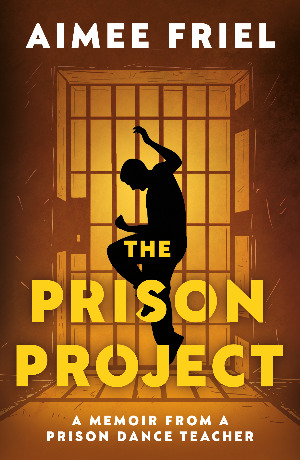 The Prison Project by Aimee Friel chronicles her attempt to bring the therapeutic benefits of dance to young offenders at a Glaswegian prison. As the same age as most of her charges, Friel had her work cut out during her tenure there. Luckily for her, she has Sam – an older and more experienced dancer, especially in this line of work.
As you might expect with an account based on real people, the names and details of the inmates have been changed to avoid identification from those in the know. What has been kept though is the ‘colourful language’ that the young offenders. If you’ve ever read Irvine Welsh’s Trainspotting, you’ll know what to expect.
Even in ‘the outside world’, men don’t usually take up dancing on a regular/serious basis unless they considering a career in the performing arts (or use it as a tool to socialise with/impress ladies!), so Friel and Sam ‘had their work cut out’ trying to win over a large group young repeat offenders, who proritise ‘not looking stupid’ in front of others and who are not likely to meet the opposite sex anyway. Be that as it may, Sam and Friel manage to secure a small quorum of offenders who attend the classes and in ‘Brandy’s’ case, he eventually learns enough to be trusted with leading the classes himself.

As well as what happened during her time teaching, Friel is very forthcoming about what else was going on in her life at the time. Friel has unconditional love and support from her grandparents, who she visits regularly. Without giving anything anyway, Friel’s relationship with them (in the book anyway) is her primary source of emotional support, but it’s interesting how the relative absence of her parents make sense towards the end of The Prison Project, when wisdom replaces ‘innocence’ and happiness.
Even though her relationship with the ‘red flag’ boyfriend is less than ideal, for the most part Friel describes having a nice life, and has never known emotional or physical hardships. With this in mind, I couldn’t help but wonder how effective she would be in a pastoral capacity at the prison.
Along with Sam, Friel uses the physical exercises to obliquely break down the barriers that men have in prison and not be in heightened state of apprehension. But outside the ‘safe space’ of the rehearsal room, it crossed my mind that to some degree it was ‘necessary’ for inmates to have their guard up and be mindful of their surroundings, knowing the potential dangers in prisons.
Throughout her book, Friel references books and research she conducted ahead of her periods of teaching and for the most part, I could understand why she would find them of value, such as Jim Rohn’s quote, “You are the average of the five people you spend the most time with,” and the role of adverse childhood experiences in adolescent development. But as Friel candidly pointed out, she was only 21 years old when she started working prisons – being more or less the same age as the young offenders in her charge –some of whom have been in care in their formative years. At the same time, she’s not had any comparable ‘life experience’ while growing up. With this in mind, who really was teaching who?
Also, one of the books that Friel quotes verbatim is Untamed – a memoir by Glennon Doyle. In addition to Doyle’s autobiographical anecdotes, it touches upon feminism, social justice, motherhood and parenting, and freedom from conditioning. Untamed’s excerpts that are included in The Prison Project do for the most part make sense, but there are other hypotheses Doyle makes about men which are not based on case studies or personal experience, but on assumptions made regarding masculinity and sexuality. A classic case of ‘2+2=22’. But because Friel (while writing this book at least) hadn’t the wherewithal or experience to utilise critical thinking with what she’s read, everything that Doyle says is accepted unconditionally, without caveats.
Yet there are still positive things to note. ‘Doublethink’ – an Orwellian term to describe holding two opposing opinions simultaneously – is a theme that is present in The Prison Project. For Friel, while she in principle believes rehabilitative courses should be for all (such as for the ‘good students’ like Brandy and Stephen), faced with having to teach offenders of the most severe crimes triggers a dichotomy in her thinking – less absolute certainty now and more nuance. Previously, Friel could arguably be said to follow the philosophical principle of Ockham’s razor, ‘where all things being equal, the simplest answer is the correct one’. But as the book progresses Friel admits her own instincts about people aren’t 100% correct or trustworthy and (to quote Lord of the Rings), she realises that with some people they “look foul and feel fair” while it’s possible for others to “look fairer and feel fouler”. But people are capable of being both at some point in their lives…
It has to be said that while I may have misgivings about aspects of the conclusions made in The Prison Project, there is no denying that it is a sincere and well-meaning attempt to show the positive aspects of dance in the correctional system. Whether the author realises it or not, I think that the selling point of the book is how a young woman with very little life experience finds her preconceptions about prisoners – and her own family – challenged, and where she finds herself (in every which way) in her post-Prison Project life.
It’s evident by the end of the book that this period of Friel’s life – where the morally grey areas of prison and revelations of her own family become entwined – has changed her world-view forever. As well her own personal development, Friel’s epiphany awakened her social conscience and she is now able to perceive the holistic nature of societal problems. To the outside world, that may not sound impressive, but in self-actualisation it is everything.
© Michael Davis 2026
The Prison Project is available to buy from The Book Guild from 28th April 2026
ISBN: 9781835744000 Price: £9.99
Find out more at https://bookguild.co.uk/bookshop/memoir/the-prison-project