Compact point-and-shoot 35mm cameras aren’t for every photographer. But I’ve yet to meet a photographer who likes them who does not love the Olympus Stylus. What the Stylus takes away in control — which is everything — it gives back in fun and great quality photographs in decent-and-better light.
A caution, however: the Stylus was introduced in 1991. If it were a person, it’d be old enough to remember 9/11. It’s full of electronics that will eventually fail, and nobody can repair them. If you buy one, enjoy it to the hilt while it lasts. It might be ten years — or ten days.
First impressions
This is a cute little camera, about the size and form of a bar of soap. At least its black plastic body isn’t slippery.

Its cover slides out of the way, turning the camera on. It’s ready in less than a second. As you can see, a flash is built in.

Controls are all on the top, and they’re simple. A button controls flash modes; another controls the self-timer. The biggest button takes the photo. The LCD shows frame number, flash mode, and battery status.

I love that the viewfinder is centered over the lens. That’s a great way to help whatever you put in the center of the frame be in the center of the photograph.

The Stylus doesn’t look like much, but that’s because it’s a sleeper. Its unassuming exterior masks a terrific usage experience and the great photographs it makes.
Technically, this camera is actually called the ∞ Stylus, or “Infinity Stylus.” Outside the United States it’s sold as the µ[mju:] — µ is the symbol for “micro” and is prononuced myoo.
Specifications and features
The Olympus Stylus features a three-element triplet lens, 35mm at f/3.5. The lens focuses automatically from about 1.1 feet to infinity; the viewfinder shows parallax correction marks for close subjects. Half-press the shutter to lock focus. There’s just one focus point, at the center.
The camera’s programmed electronic shutter runs from 1/15 to 1/500 second, with center-weighted metering handling exposure automatically. There’s no exposure compensation control. Film speed selection is automatic via DX coding, reading ISO 50 through 3200. For non-coded film, the camera defaults to ISO 100.
The built-in flash offers four modes: auto (fires in low light and backlight), auto with red-eye reduction, flash off, and fill flash. Flash settings reset to auto every time you close the cover. A self-timer provides a 12-second delay. The camera includes automatic film loading plus advance and rewind.
Dimensions are roughly 4.6×2.5×1.5 inches, and the camera weighs about six ounces empty. The viewfinder is an active-type 0.4x finder. Next to it are indicator lights for flash and autofocus confirmation.
The Stylus runs on a single CR123A 3-volt lithium battery, without which the camera is a brick.
If you like point-and-shoot cameras, I’ve also reviewed Canon’s Snappy 50 (here) and Sure Shot Z180u (here), Kodak’s VR35 K12 (here) and VR35 K40 (here), Olympus’s Stylus Epic Zoom 80 (here), Minolta’s Talker (here), and Nikon’s 35Ti (here). Or check out all of my camera reviews here.
Usage impressions
You’ll be hard-pressed to find a more pleasant nice-day casual-shooting camera than the Olympus Stylus. Slip it in your back pocket and go. When you want it, you can flick the cover open while you bring it to your eye. Frame, press, done — and then you get good images in all but the most complicated lighting situations.

The Stylus’s mission is quality photographs in good light. As such, Olympus chose well when it fitted a 35mm lens. That’s in the sweet spot for everyday photography of family and scenery.

I usually favor color negative film in my point-and-shoot cameras. But because the Stylus’s lens is contrasty, I reach for black-and-white film a little more often.

The Stylus is supposed to lock the shutter when your subject is closer than 1.1 feet. The green light next to the viewfinder blinks when that happens. But it’s focusing at the very center of the frame, and things around that point might be closer than 1.1 feet.

Given the simple triplet lens, it’s not surprising that it vignettes slightly. It’s generally very faint. I like to boost contrast in post-processing, which tends to bring it out, as in this image.

The Stylus’s viewfinder is fairly accurate. That’s a big deal for me — what I center in the viewfinder should be centered in the photograph. Unlike so very many point-and-shoots, the Stylus does well here. In the image above, I centered the triangle sign in the viewfinder. It’s horizontally centered on the negative, riding slightly above center vertically.

The center-weighted metering system reads light across the frame but gives more weight to the center area, and it’s aiming for middle gray. This photo with lots of light and shadow is probably at the extremes of what the meter can handle. For scenes with lots of bright sky or snow or sand, it’ll tend to underexpose. For very dark scenes, it’ll overexpose trying to lift them to middle tone.

Night photography is beyond the Stylus, even with extremely fast film. I tried shooting ISO 3200 film in it once on a nighttime walk in Chicago’s Loop. Most images were seriously misexposed. But that tracks. I was asking it to navigate deep blacks and bright whites, and it was desperately searching for middle gray. This was the best-exposed image on the roll.
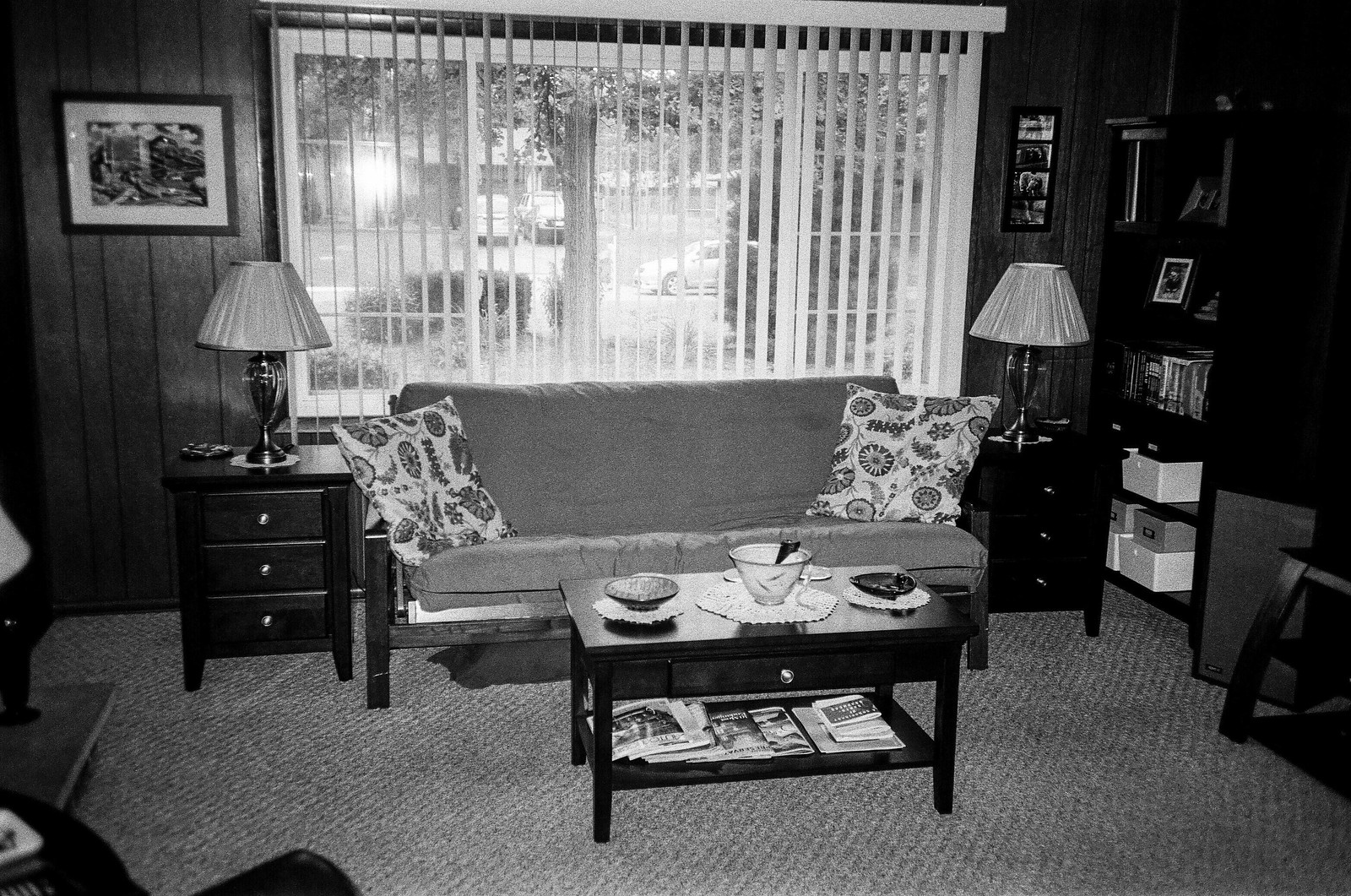
I seldom use flash, at least not on purpose. On the rare occasion I’ve used it deliberately, it lights evenly. The orange lamp next to the viewfinder lights when flash is needed.

In auto mode I find flash to be a touch too aggressive, occasionally firing on a scene where I think there should be enough available light. In this photo, it served only to cause that bicycle’s reflectors to light up. Flash fills automatically when the scene is very obviously backlit, which is nice. When that happens, both the green and orange lamps light next to the viewfinder. You can force fill flash, too.

I normally leave the Stylus in my back jeans pocket until I need it. If I’m shooting a lot, I wrap the strap around my wrist and carry it in my hand. When I put it back into my jeans pocket, sometimes the cover slides open. In theory, that risks abrading the lens.

In recent years my Stylus has started showing signs of wear. It leaks light every once in a while, as this photo shows. Also, the battery-door latch clip broke and I now hold the door closed with gaffer’s tape. So it goes with decades-old point-and-shoots.

The Stylus often gets compared to its successor, the Stylus Epic, a.k.a. the µ[mju:] II. It’s sleeker, has a slightly faster lens, and offers spot metering. But for the good-light, casual shooting I do, the Stylus Epic can’t do anything better than the Stylus.
To see more from this camera, check out my Olympus Stylus gallery.
The bottom line
I’ve owned an Olympus Stylus since 2011, when you could buy them on eBay for $30. Those days are long gone — these go for $200-300 now. As much as I love mine, when it dies I’m not replacing it. I reserve that kind of scratch for cameras that can be repaired.
That said, when my Stylus kicks it, I’m going to miss it a lot. It’s been a great companion over the years, and is one of the cameras in my collection I’ve reached for most often.
Read other perspectives on the Olympus Stylus from Josh Solomon, Max Kent, Gage Fletcher, and Dmitri.
If you like old film cameras, check out all of my reviews here!
To get Down the Road in your inbox or feed reader, subscribe here.