Raghu Parthasarathy has put together a few graphs looking at labor salaries at the University of Oregon. This isn’t the first potential observation of what others have termed “administrative bloat” at research universities, but the flatness of professors at budget category makes for a useful comparison of slopes.
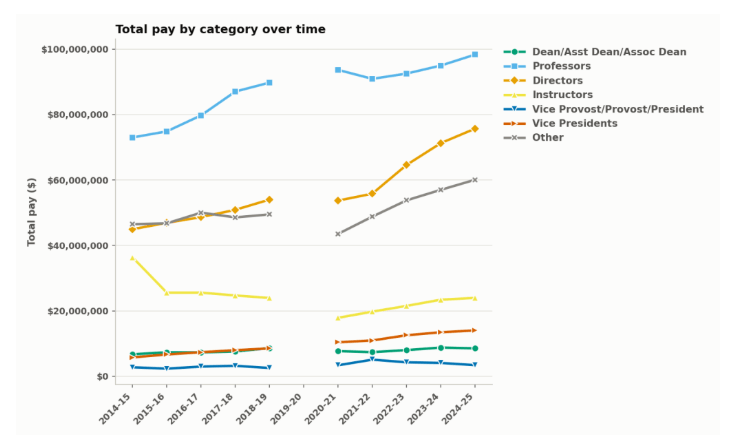
I don’t know whether this is good or bad, but it does leave me with a couple questions
- What do Directors do?
- What is getting bundled into “Other”?
For directors, this could be a lot of things. They could be directing centers launched with private money, which means they are perfectly likely to be research professionals without teaching obligations and at-will contracts outside the tenure track ecosystem. They could, however, also be service professions working on the sports, entertainment, and student services side of things. The pool, the gym, the student outreach center – perhaps the scale of each now requires their own bespoke middle management position.
“Other” is, of course, far harder to parse without doing some actual digging, which of course I am in no way willing to do.
Is this bloat? Is it an academic institution drifting away from research and other forms of traditional public service? Not sure. What I am confident in is this is further evidence of the attractiveness of employee slots unattached to tenure. I’ve written before on what tenure is and how it is intended to be leveraged as a mechanism within the production of scholarship. Maybe the University of Oregon is simply trying to deleverage from tenure. Or maybe the bundle of goods being offered is more complex than previously, requiring a new layer of middle management. I’m curious if any of our readers have additional insight for the comments. Because, at the very least, this is more evidence that what is being produced at major universities is changing.