I was playing duplicate bridge yesterday with a robot partner and two robot opponents.1 I'm south, and my partner is north. We had the following bidding auction, and I've included my cards so you can see the auction from my perspective:
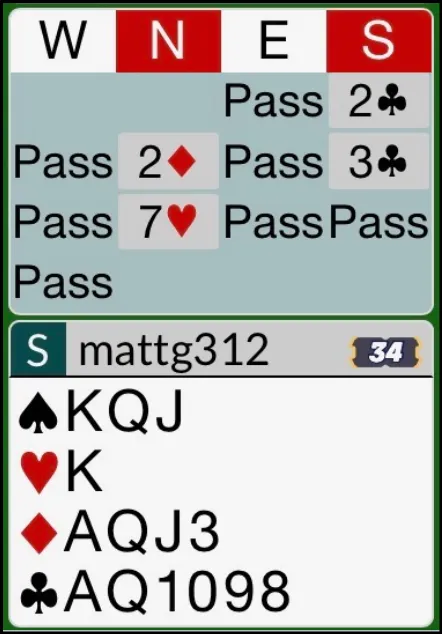
My right hand opponent passes. My first bid is 2♣️, because I have a monster hand—I'm holding more than half the high cards points2 in the deck—and 2♣️ is an artificial bid that says "partner I have a huge hand, you may not pass, I will tell you more about my hand next bid." My robot partner obliges by bidding 2♦️, which is also an artificial bid that says nothing about his hand, it just fills space so that I get another bid.3
So far, so good. It gets back to me and now that we've established I have a monster hand, I start to describe it. My 3♣️ bid shows an unbalanced hand with length in clubs. Depending on how partner responds, it seems likely that we will either finish up in 3 Notrump4 or, if partner has a good hand too, explore the possibility of maybe bidding a slam.5
My partner now bids 7♥️. I literally LOL'd. This bid requires us to take all 13 tricks, with hearts trump. Notice that I have not told partner anything about the hearts in my hand; I could have zero hearts. It implies that partner has a tons of hearts and that, combined with what partner knows about my hand (huge hand, ~21+ HCP) we do not have a loser in any suit (i.e. the opponents can't play an Ace off the top and beat us).
I have played tens of thousands of hands of bridge, against humans and robots. I have never seen a bid like this. It violates a core principle of bidding big hands: go slow. When you jump in the bidding like this, you eat up all the room you have to describe your hand and ask your partners questions. The bigger the hand, the slower you want to go. We have all sorts of systems to find out how many Aces we have between us and other useful information that might allow us to stop short of a grand slam if it turns out we can't actually make it. But we can't do any of those things, because the robot has jumped all the way to the grand slam.
Now, maybe partner has a hand that he knows can make 7♥️. In that case, the bid might make sense, in theory. If he knows we have 13 tricks, and the only way the opponents could stop us is if one of them has a void and could get a lucky ruff before we drew trumps, quickly getting to our grand slam would deny the opponents the ability to signal a void6 during a slow bidding sequence.
Can partner actually know this at this point? It's possible, but extremely unlikely. Imagine them holding a hand like:
♠️ A ♥️ AQJT985432 ♦️ K ♣️ K
If they assume I have 21 or more HCP, they can add their 17 HCP and see we have a combined 38, which means I have to have the A♣️, A♦️, and K♥️.
In theory, they could also have a hand like:
♠️ A ♥️ AQJT98576432 ♦️ --- ♣️ ---
Notice that, since I have the K♥️, they really need to have 12 hearts to know we don't have a heart loser. If they simply had
♠️ A2 ♥️ AQJT9857643 ♦️ --- ♣️ ---
that would be vulnerable to East winning a trick holding ♥️K2, and thus you would want to bid slowly and diagnose things.
The big issue here is that I have the A♣️ and A♦️, which means they have to have either a ton of HCPs so they can rule those out of the opponent hands via brute force, or they need voids in those suits so they don't have to worry about losing any tricks there (they can just ruff them with hearts).
But, with the robot partner already bidding 7♥️, there's nothing I can do but pass and hope we make it. We are past the point of diagnosing anything.7
So, I pass. West leads the 9♦️ and we get the big reveal:
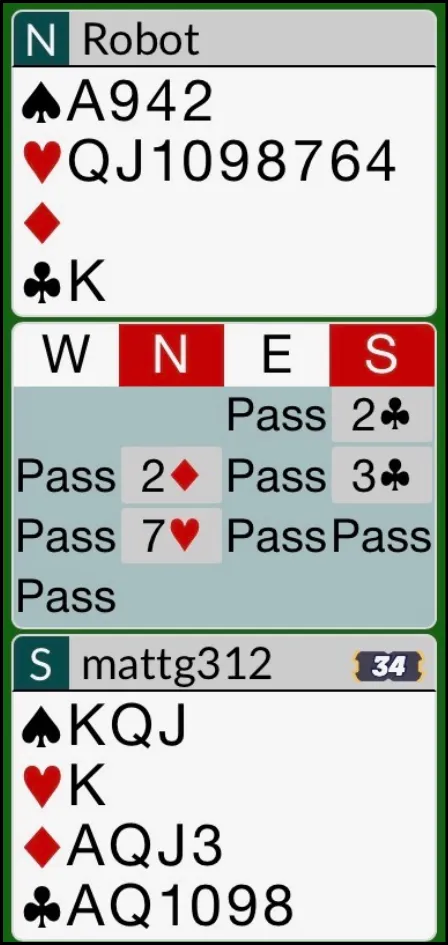
So yes, a completely idiotic bid by the robot. We are missing the Ace of trumps, so we are not making 13 tricks. And if we go slow and diagnose things, we may very well end up in the excellent 6♥️ contract.
In this format, I'm actually playing against 100 other humans, all of whom are sitting in the same seat as me, getting the same cards, and also playing with a robot partner against two robots. Your score is derived from how you do compared to how the other human players do in the identical situation.↩
The classic way to count high-card points in bridge is Aces are worth 4, Kings 3, Queens 2, and Jacks 1. This puts 40 points in the deck. Typically, making a contract worth a game bonus takes about 25 combined points between partners and making a slam takes about 33 combined points, but these numbers can vary widely if partners have long suits or voids that fit together well. In some cases you can makes games or slams on very few points if things fit together perfectly, and diagnosing this is a big part of bidding skill.↩
A bridge auction ends when three players in a row pass. If my partner were to pass instead of bidding something, the auction would end and we would be playing in a contract of 2♣️.↩
3NT is a contract to take at least 9 tricks with no trump suit. It's a very common contract, because it is the lowest contract level at which you qualify for the game bonus in bridge, which here would be worth an extra 500 points.↩
A slam in bridge means taking either 12 tricks (small slam) or all 13 tricks (grand slam). These equate to bids at the 6 and 7 level. It is worth a lot of extra points; here, it would be worth 750 or 1500 additional points, beyond the game bonus. You only get the bonus points (for game or slam) if you bid the contract; Stopping at 3NT but making 12 tricks does not get you the small slam bonus. You have to bid 6NT.↩
The opponents might do this by doubling one of our artificial bids enroute to our final contract, which is basically costless to them but allows them to signal things.↩
I could bid 7NT, and there might be an argument for that. The problem is that if the robot has a spade void, we would be down immediately in 7NT to the opponent Ace, where we could survive in 7♥️.↩